
Experimentation
HouseZero’s one-of-a-kind Internet of Things (IoT) architecture and patented network infrastructure make it a hub for innovation in building operation and design. HouseZero enables researchers to test new ideas – from advanced software to sustainable materials – that strategically extend the boundaries of architecture and technology.
The building’s IoT framework seamlessly integrates a communication network, sensor network, and operations network, creating both a multiscale physical and digital testbed for research that fuses real and synthetic data. An independent server developed by the Center for Green Buildings and Cities (CGBC) allows researchers to securely access real-time and archival data, develop AI-based data-driven algorithms, and deploy control strategies that respond to the building’s performance in real time (Malkawi et al., 2023).
With hundreds of sensors embedded throughout the structure, HouseZero generates millions of data points (Han et al., 2024). This continuous flow of information supports live visualizations, virtual simulations, and “What if ?” scenarios that help researchers explore new ways to enhance building efficiency and occupant comfort.
Through the combination of physical experimentation and computational modeling, HouseZero fosters collaboration across disciplines and generates new insights into how buildings can perform more efficiently for the benefit of people and the planet.
Physical Experimentation (LiveLab)
Most experiments begin in HouseZero’s LiveLab, a flexible, precisely monitored experimental space connected directly to the building’s energy exchange system and its digital twin. From there, experiments can be deployed across the building’s many controllable zones, enabling real-world testing of next-generation building systems.
Experiments Include:
SNIFFIA, October 2025
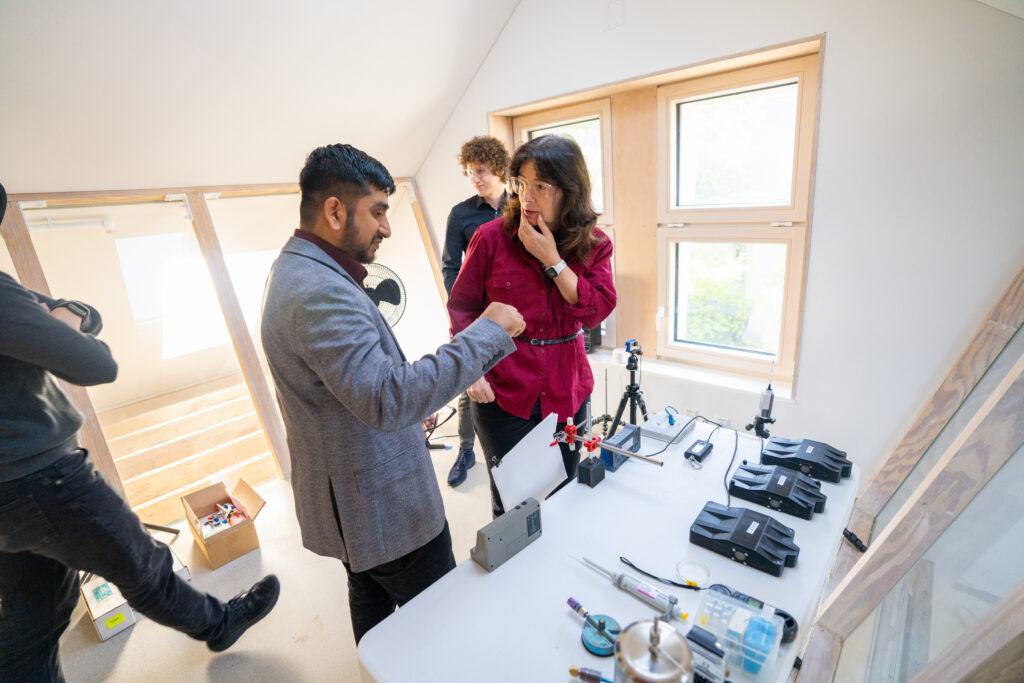
Building on the results of the 2024 experiment, in October 2025, researchers from the Wyss Institute and Harvard School of Engineering and Applied Sciences conducted a second field study of the bioinspired indoor air quality sensor, SNIFFIA, at HouseZero’s LiveLab. SNIFFIA is a “living sensor” inspired by canine olfaction that actively samples surrounding air and adapts to real-time data through machine learning and AI.
The three-week field study consisted of three main components: test the sensors accuracy against commercially available products, compare three sensor sniffing sequences to improve air sampling techniques, and deploy different algorithms to determine which best supports energy optimization and occupant well-being.
SNIFFIA, July 2024
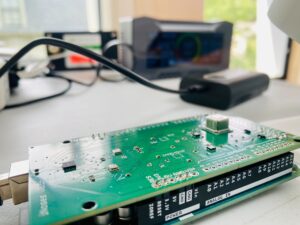
In July 2024, a team of researchers from the Aizenberg Lab tested the performance of a new bioinspired indoor air quality sensor, SNIFFIA, in HouseZero’s LiveLab. Lead researcher Haritosh Patel—affiliated with the Aizenberg Lab, the Wyss Institute, and the Harvard School of Engineering and Applied Sciences—worked alongside collaborators from the Harvard Graduate School of Design and the University of North Carolina at Chapel Hill.
The goal of the study: to evaluate SNIFFIA’s accuracy in detecting various indoor pollutants and volatile organic compounds (VOCs) such as formaldehyde and benzene. To simulate real-world conditions, the team introduced common office items such as rugs, whiteboards, and highlighters to observe the types of VOCs emitted and assess the sensors detection capabilities.
Over the three-week trial, approximately 6 million data points were collected. This dataset was then used to train machine-learning models, enhancing SNIFFIA’s VOC detection accuracy.
Discover more about SNIFFIA:
• The Harvard Crimson
• Fast Company
VESMA, August 2023
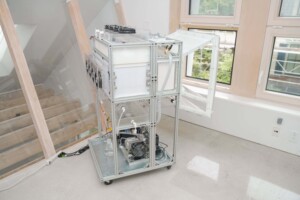
In August 2023, a prototype of Vesma – a refrigerant-free, eco-friendly cooling solution for all climates – was installed and tested at HouseZero’s LiveLab. The technology was developed by an interdisciplinary team from the Harvard John A. Paulson School of Engineering and Sciences (SEAS), Wyss Institute, and the Harvard Graduate School of Design, including CGBC faculty members Jonathan Grinham, Martin Bechthold, and Joanna Aizenberg.
Vesma is a combination of two technologies: cSNAP (an evaporative cooling technology) and a vacuum membrane dehumidification system. The field study demonstrated that Vesma could effectively provide energy efficient, refrigerant-free cooling and outperform a typical vapor-compression air conditioner in delivering comfortable indoor conditions.
Discover more about Vesma:
• Wyss Institute
• Harvard Graduate School of Design
cSNAP, August 2022
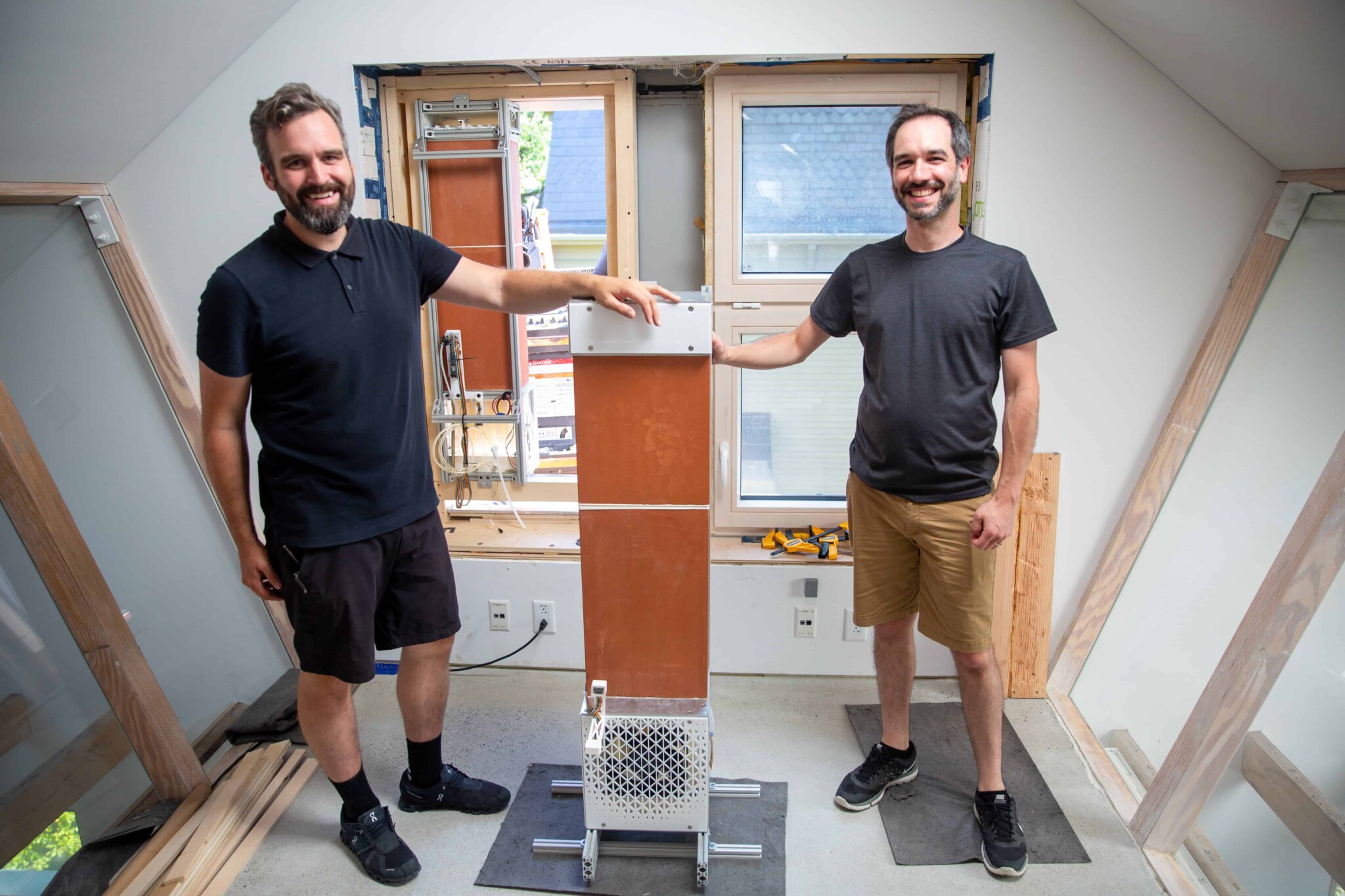
In August 2022, a team of scientists and designers from the Wyss Institute, Harvard Graduate School of Design (GSD), and the Harvard Center for Green Buildings and Cities (CGBC), tested a new, exciting proprietary technology, cSNAP, in HouseZero’s LiveLab.
cSNAP is a durable, low-cost, low-energy evaporative cooling technology that uses up to 75% less energy than mechanical vapor compression air conditioners. The test of the novel technology was conducted on hot, humid summer days and showed that it effectively cooled indoor air even in extreme conditions.
Discover more about cSNAP:
• Wyss Institute
• Fast Company
• Washington Post
• Harvard Magazine
Computational Experimentation
HouseZero undergoes continuous monitoring and computational experimentation at multiple scales, from testing individual zones to the entire building. Experiments may run on a daily, weekly, or long-term basis and involve developing AI-based data-driven algorithms and deploying control strategies to the building to research energy efficiency and occupant comfort.
These experiments are enabled by HouseZero’s one-of-a-kind IoT architecture and sophisticated sensor networks. This patented infrastructure has also been the basis for several doctoral dissertations and research projects. The results from many of these experiments have been documented in peer-reviewed papers. For more information: publications.
Experiments Include:
AI based code to optimize CO2 and energy consumption
Most building management systems still rely on siloed, rule-based control that cannot optimize interactions between subsystems. This experiment deployed an asynchronous Multi-Agent Deep Reinforcement Learning Controller (MA-DRLC) in HouseZero’s LiveLab to coordinate single-sided natural ventilation (window actuation) with thermally activated radiant floor cooling. Two cooperating agents learned from real-time sensing to balance thermal comfort, indoor air quality, and energy use. In office operations, MA-DRLC maintained comfort and IAQ targets for over 90% of occupied hours while reducing cooling runtime by approximately 21% relative to conventional rule-based control. The controller was subsequently extended to additional HouseZero zones to evaluate generalizability and long-term robustness.
Conducted by Elence Xinzhu Chen, Postdoctoral Research Fellow, Harvard Center for Green Buildings and Cities.
Multi-Objective Health, Comfort, and Energy Optimization in HouseZero
This research uses advanced VOC sensing at HouseZero to extend traditional building management inputs beyond temperature, CO₂, and relative humidity, enabling real time tracking of individual pollutants that are relevant to long term human health. By embedding these new health related signals into the control logic, the work constructs a multidimensional “energy–comfort–wellness” landscape that links energy use, short term comfort, and long term wellness outcomes. Computational algorithms then traverse this landscape to approximate optimal operating boundaries, aiming to maximize occupant health and comfort while simultaneously minimizing energy consumption in HouseZero’s ultra efficient, sensor rich environment.
Conducted by Raphael Ehrmaier, Fellow in Materials Science & Mechanical Engineering at Havard SEAS.
Marginal emissions contribution
In this experiment, WattTime’s 24-hour forecast of marginal emissions was used to control HouseZero’s heat pump operation. WattTime is an environmental tech nonprofit that provides real-time and forecasted data on grid emissions. For each hour of the experiment, the forecasted emissions were compared to a predefined threshold; if the emissions exceeded that threshold, the heat pump was scheduled to turn off for that hour. To prevent short cycling and protect both comfort and equipment, a minimum on time of two hours, a minimum off time of one hour, and a maximum continuous off time of three hours was enforced. Together, these rules allowed the heat pump to shift operation away from the “dirtiest” hours on the grid while still maintaining reasonable and stable operation.
Conducted by Yiwei (Lucy) Lyu, Doctor of Design student at the Harvard Graduate School of Design.
Model predictive control for mold prevention in a naturally ventilated building
The research investigates mold-risk mitigation by integrating natural ventilation and thermally-activated building systems (TABS) cooling within a Dynamically Tuned Weight Model Predictive Control (DTW-MPC) framework. The controller uses predictions of surface temperature and humidity to anticipate conditions that may lead to mold-proliferation, while a Mold Germination Graph (MGG) model provides continuous long-range evaluation of moisture-safe operation without active dehumidification. The DTW-MPC then optimizes windows and valve controls accordingly. The system was calibrated through digital-twin testing and deployed building-wide in HouseZero during the summers of 2024 and 2025, achieving consistent mold-safe conditions.
Conducted by Sunghwan Lim, Ph.D. student at the Harvard Graduate School of Design and Sang Won Kang, Doctor of Design student at the Harvard Graduate School of Design.
Data-driven solar chimney control for naturally ventilated buildings
This research investigates the year-round applicability of a solar chimney, focusing on its use for wintertime ventilation and for optimized cooling in other seasons through data-driven modeling and control. Data collection is used to capture a wide range of occupancy patterns and thermal conditions for generalized model training. The goal is to develop a data-driven model control strategy to allow for optimal solar chimney use coupled with window operation in both summer and winter.
Conducted by Sunghwan Lim, Ph.D. student at the Harvard Graduate School of Design.
A field study on data-driven heating demand prediction for load reduction of ground source heat pump
Ground-source heat pump (GSHP) operation accounts for a considerable amount of the total energy consumption in HouseZero. An in-depth analysis of historical operational data revealed a substantial amount of standby power use in GSHP. This inefficiency stems from a simple rule-based on/off control strategy that relies solely on weighted outdoor temperature forecasts. To forecast periods without heating demand and, thereby, keep the GSHP off, a data-driven model for predicting slab temperature was trained using HouseZero’s historical data. The control algorithm turns off the heat pump when the slab temperature is predicted to remain above the heating setpoint for the next two consecutive hours. Field studies conducted during the 2023 and 2024 winters show that the heat pump’s COP increased by approximately 10% compared with years using the rule-based on/off strategy.
Conducted by Sunghwan Lim, Ph.D. student at the Harvard Graduate School of Design.